Exploring Global Tales | Resources & Activities
Folktales are stories that have traveled across time and around the world. Way before people wrote books, communities shared these tales aloud – passing on wisdom, humor, traditions, and important lessons.
Exploring folktales helps students build reading skills while also helping them understand how people in different places explain the world, solve problems, and teach values.
Disclosure: This post contains affiliate links. By clicking through and making a purchase, we receive a small commission at no extra charge to you. All proceeds help support our free global education website. Thank you!
Discover 10 folktale types – from fables and trickster tales to myths and legends.
Each section below includes a simple definition, picture book examples, and an any-tale comprehension activity you can use with titles you have access to.
Use these helpful resources during World Folktales & Fables Week in March, for a genre study any time of year, or as a quick reference when you’re planning read-alouds.
Looking for even more titles? At the end, you’ll find a link to a larger collection of suggested folktales and fables you can browse for your classroom library and lesson planning.
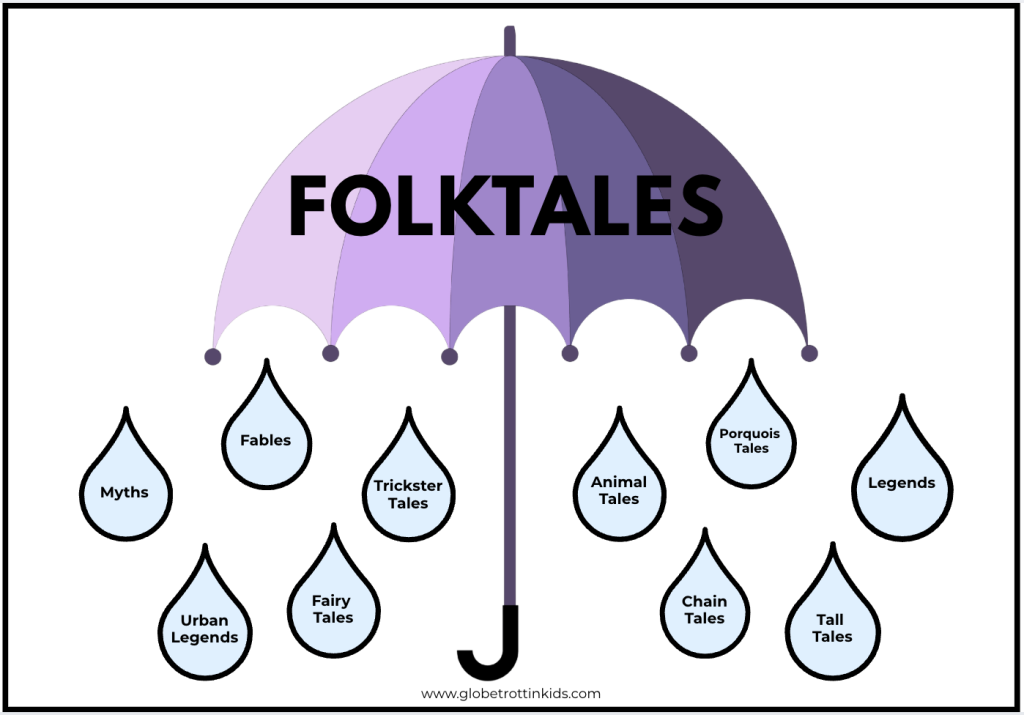
☂️ FOLKTALES: A long-ago traditional story that people shared out loud for generations. Folktales often have ordinary people or animals as characters and include problems to solve, clever choices, and lessons about how to live and treat others.
💧 FABLES: A short traditional story told to teach a clear lesson, called a moral. Fables often use animals that talk and act like people, and the lesson is usually easy to spot at the end.
- Aesop’s Fables (Greece)
- The Lion & the Mouse (African Serengeti)
- The Empty Pot (China)
- The Monkey and the Crocodile (India)
Moral Match: Students choose one sentence that states the moral and 2 pieces of evidence (what the character did and what happened as a result).
💧 ANIMAL TALES: A traditional story where animals are the main characters and act in animal-like ways (even if they can talk). Animal tales often explain animal behavior, show how animals survive, or teach a lesson about cleverness, kindness, or consequences.
- Why Mosquitoes Buzz in People’s Ears (West African tale)
- The Great Kapok Tree (Amazon rainforest)
- The Mitten (Ukrainian folktale adaptation)
- The Lion’s Whisker (Ethiopian)
- The Little Red Hen (European/American tradition)
Cause & Effect Chain: Students complete “Because ___, then ___. This led to ___. Finally ___.“
💧 TRICKSTER TALES: A traditional story about a clever character who solves problems using tricks, jokes, or sneaky plans. Trickster tales can be funny, but they also show how choices affect others – and sometimes the trickster learns a lesson, too.
- Anansi the Spider (West Africa/Caribbean)
- Coyote: A Trickster Tale from the American Southwest (Indigenous-inspired retelling)
- Jabuti the Tortoise: A Trickster Tale from the Amazon (Brazil/Amazon region)
- The Fox and the Crow (Aesop)
Trickster Decision Maker: Students list 3 choices the trickster makes. Label each “smart/unfair/both” with evidence. Discuss: Who benefits? Who is hurt?
💧 POURQUOI (por-KWA) TALES: A traditional “why” story that explains why something in nature is the way it is – like an animal’s behavior, a plant’s shape, or a natural sound. These stories are imaginative explanations passed down over time.
- Why Mosquitoes Buzz in People’s Ears (West Africa)
- Why the Sun and the Moon Live in the Sky (African)
- How the Leopard Got His Spots
- How the Stars Fell into the Sky (Native American/Navajo)
Mystery Explanation Map: Students answer 1) What “why” question is the story answering? 2) What events explain it? 3)What is the final explanation?
💧 FAIRY TALES: A make-believe story that uses magic – like spells, enchanted objects, giants, witches, or fairies. Fairy tales often include a big problem, a surprising twist, and an ending where good and evil are clearly shown.
- Yeh-Shen: A Cinderella Story from China (China)
- The Three Billy Goats Gruff (Norway)
- Rumpelstiltskin (Germany)
Magic Helper & Rule: Students identify the magical element (or “special help”) and write two rules it seems to follow. Then: How would the story change if the rule changed?
💧 CHAIN TALES: A traditional story built like a “link-by-link” chain, where the same lines, events, or characters repeat and grow as the story goes on. Chain tales are meant to be fun to tell, easy to remember, and satisfying because of their predictable pattern.
- Stone Soup (European)
- The Gingerbread Man (American)
Repetition for a Reason: Students highlight repeated words/phrases and explain: How does repetition help readers? (predicting, humor, memory, rhythm)
💧 MYTHS: A very old traditional story that a group of people told long ago to help explain big mysteries – like why nature acts a certain way or why people should live by certain values. Myths often feature gods, goddesses, heroes, or magical beings.
- King Midas and the Golden Touch (Greece)
- Ganesha’s Sweet Tooth (India)
- Taming the Sun: Four Māori Myths (New Zealand)
- Feathered Serpent and the Five Suns: A Mesoamerican Creation Myth
- Persian Mythology: Epic Stories of Gods, Heroes, and Monsters)
Power and Purpose Chart: Who has power and what does it teach?
Make a chart with 3 columns:
- Powerful being/object (god, spirit, hero, magical item, natural force)
- Power shown (what they can do – change seasons, create mountains, etc.)
- Message for people (what the myth teaches/warns/explains)
Include 2–3 examples from the myth.
💧 LEGENDS: A traditional story connected to a real person, place, or event from long ago, but told with details that may be exaggerated over time. Legends often explain why someone is remembered as brave, clever, or important.
- The Adventures of Robin Hood (England)
- Who Was Johnny Appleseed? (United States)
- Mulan: The Story of the Legendary Warrior (China)
Fact-ish vs. Fantastic: Make two columns: Could be real AND Fantastic/exaggerated. Discuss how legends can be both.
💧 TALL TALES: A humorous story told with extreme exaggeration – so big it couldn’t possibly be true. Tall tales often feature larger-than-life characters who do impossible things.
- Sally Ann Thunder Ann Whirlwind Crockett (United States)
- Master Man: A Tall Tale of Nigeria
Exaggeration Meter: Students find 3 exaggerated details, rate each 1–5 on “How impossible?”, and explain why the author used it (humor, excitement, bragging).
💧 URBAN LEGENDS (Modern Folklore): A story people tell as “true,” even when it’s not proven – often a “friend-of-a-friend” tale. They spread fast and change as they travel.
*Teacher note: Keep this category non-scary and focus on how stories spread, not fear.
- What Do We Know About Bigfoot? (United States)
- Nessie – The Lochness Monster (Scotland)
Source Detective: Students label story “evidence” as:
- Named source (a real person/title/place)
- Vague source (“someone said …”)
- No source
Then decide if it is reliable. Why or why not?
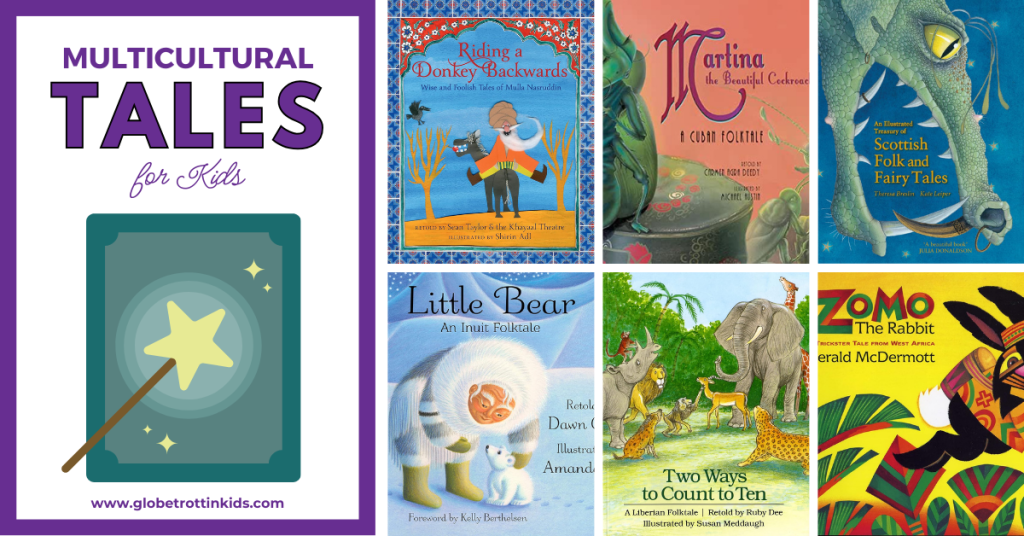
Browse our growing collection of Tales Around the World.
A Note on Respectful Retellings
Folktales come from real communities and cultural traditions, so it’s important to share them with care. When possible, name the country, culture, or specific community connected to the tale (and choose retellings that include clear attribution).
Encourage students to look for authentic details (setting, names, foods, clothing, celebrations) without turning them into “rules” about a whole group of people. Avoid activities that ask students to mix elements from different cultures into one story, and steer clear of stereotypes, accents, or costumes that could feel like pretending to be someone else. When you’re unsure about a detail, model curiosity:
“Let’s learn more,” rather than filling in gaps with guesses.