
Fortune Cookies for Everyone! Review & Activity
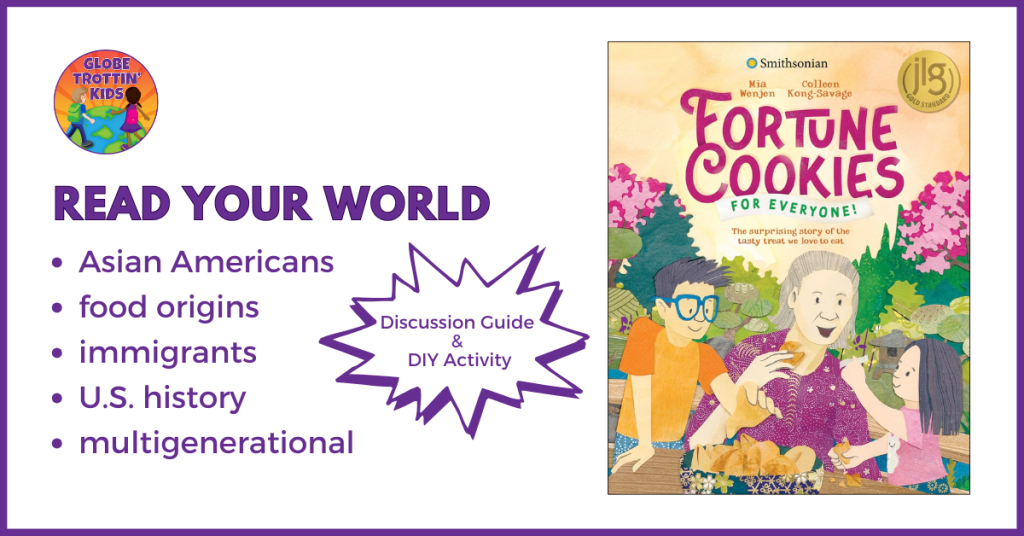
Fortune Cookies for Everyone! The Surprising Story of the Tasty Treat We Love to Eat invites readers on a warm, meaningful journey through history, culture, and family storytelling – centered around a beloved treat many children (and adults) recognize but may not fully understand.
Disclosure: We received a complimentary copy of this book for review; however, all opinions are our own. This post contains affiliate links. By clicking through and making a purchase, we receive a small commission at no extra charge to you. All proceeds help support our free global education website. Thank you!
Fortune Cookies for Everyone! The Surprising Story of the Tasty Treat We Love to Eat
The book opens with a striking spread featuring the ancient Chinese proverb, “A journey of a thousand miles begins with a single step,” immediately setting the tone for a story rooted in heritage and discovery.
When Grandma Miyako shares fortune cookies with her grandchildren, she sparks their curiosity by pulling out her scrapbook to tell the “long and twisty story” behind the famous cookie.
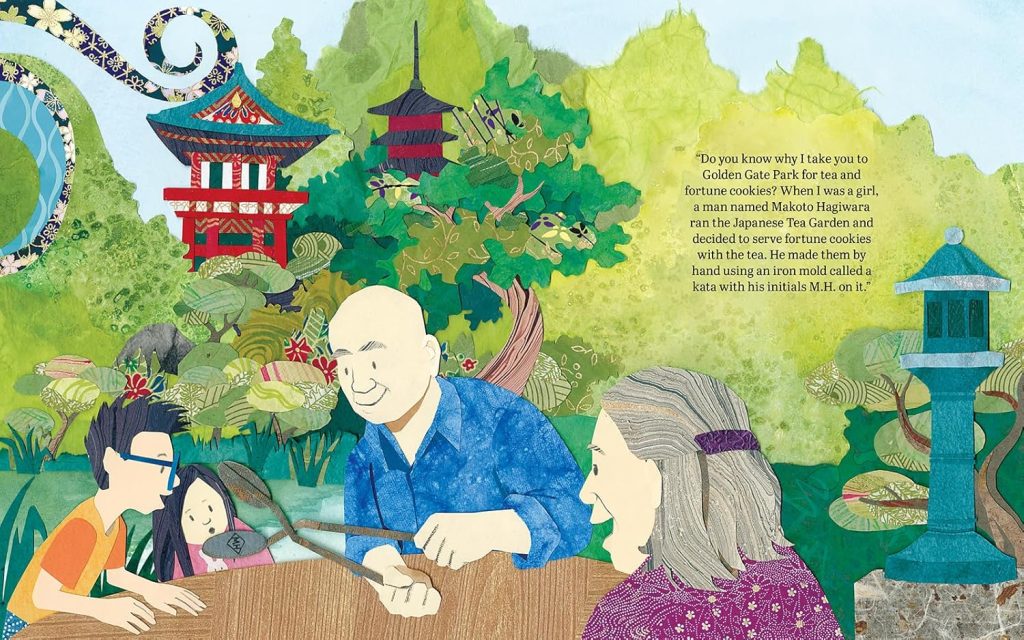
Through Grandma Miyako’s memories, readers travel back to San Francisco, where fortune cookies were served at the Japanese Tea Garden in Golden Gate Park. The story introduces Makoto Hagiwara, who crafted the cookies using a traditional iron mold called a kata. Small but meaningful details – like the initials stamped on the mold – become important clues later in the story, encouraging young readers to think like historians.
As the story continues, children learn how the fortune cookie changed right along with America. The recipe was tweaked to match new tastes (switching from salty miso to sweet vanilla and butter), machines were made to speed up production, and fortunes were tucked inside – turning the cookie into a crowd favorite. These are great examples that show how people adapted and tried new ideas.
The book also thoughtfully addresses a more difficult chapter in U.S. history. Grandma Miyako explains how, after the bombing of Pearl Harbor, Japanese Americans, including her own family, were unjustly sent to incarceration camps. During this time, Chinese American bakers continued producing fortune cookies, helping them spread nationwide. This section offers an important opportunity for age-appropriate discussions about discrimination, resilience, and justice.
Curiosity builds again when the grandchildren learn about a 1983 mock trial debating whether the fortune cookie originated in Los Angeles or San Francisco. (Read the story to discover who won – and the clue that proved it!)
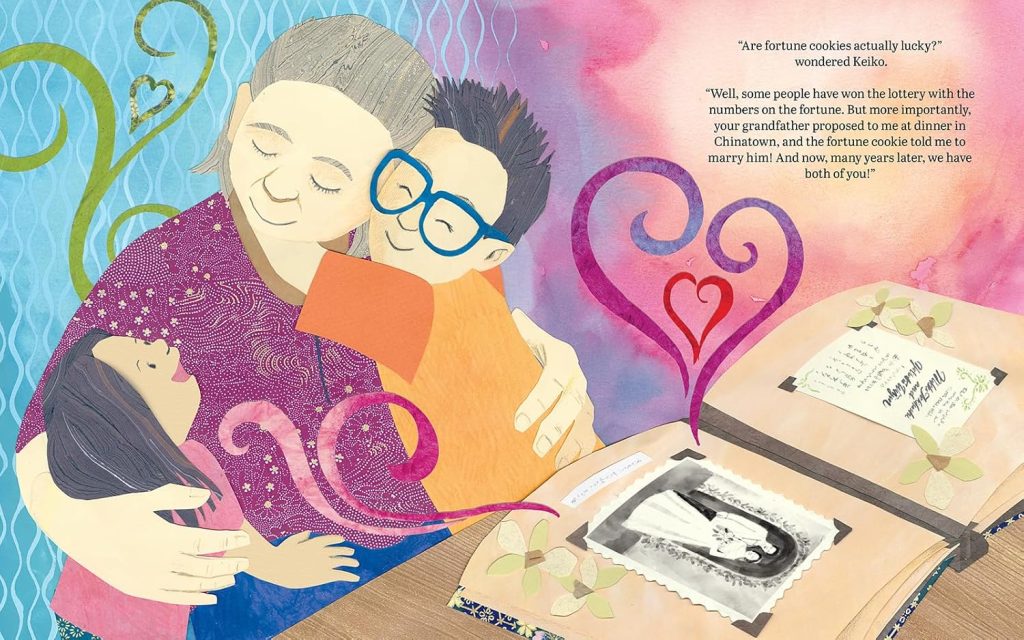
Grandma Miyako concludes her story with fond memories of buying omikuju (fortunes) in Japan and the luck a fortune cookie brought her in America.
An Author’s Note further deepens the experience, sharing the author’s personal connection and purpose for telling this story.
The illustrations are colorful, inviting, and rich in detail, blending past and present. Japanese design motifs such as kikkō (a geometric tortoise-shell pattern symbolizing longevity and strength) and tatewaku (a pattern of vertical, wavy lines that represent rising steam and the ability to rise above challenges) are beautifully incorporated.
Fortune Cookies for Everyone! offers a sweet culinary adventure while opening the door to meaningful conversations about U.S. history, immigration, perseverance, and the contributions of Asian American communities. It’s a wonderful choice for classrooms, libraries, and family reading.
Meet the Author
Mia Wenjen blogs about parenting, children’s books, and education at PragmaticMom.com. She is the co-creator of Read Your World Day (formerly Multicultural Children’s Book Day), a non-profit celebrating diversity in children’s books. Check out our reviews for some of her other titles:
- The Traveling Taco: The Amazing and Surprising Journey of Many of Your Favorite Foods
- Food for the Future: Sustainable Farms Around the World
Meet the Illustrator
Colleen Kong Savage is an Asian American graphic artist and illustrator who also creates murals. She wrote and illustrated Piano Wants to Play – a story about the special bond between a piano and a young girl, told from the piano’s perspective.
Discussion Questions
Cause & Effect
How did the fortune cookie change over time? What were some reasons people changed the recipe and how the cookies were made?
Perspective-Taking
Why do you think Grandma Miyako chose to share this story with her grandchildren? How might the story feel different if it were told by someone else?
Analyzing History & Fairness
The book talks about a difficult time for Japanese Americans during World War II. Why is it important to learn about both happy and unfair parts of history?
Making Connections
Can you think of a food, tradition, or object that has changed over time or moved from one culture to another? How is it similar to the fortune cookie’s story?
Personal Connection
The fortunes in the cookies offer messages about luck and the future. If you could write a fortune that matches the message of the book, what would it say, and why?
Activity
Learn How to Make Paper Fortune Cookies from Red Ted Art. Have students write 3-5 fortunes to insert.