Mei’s Mermaid Mission Review & Activities
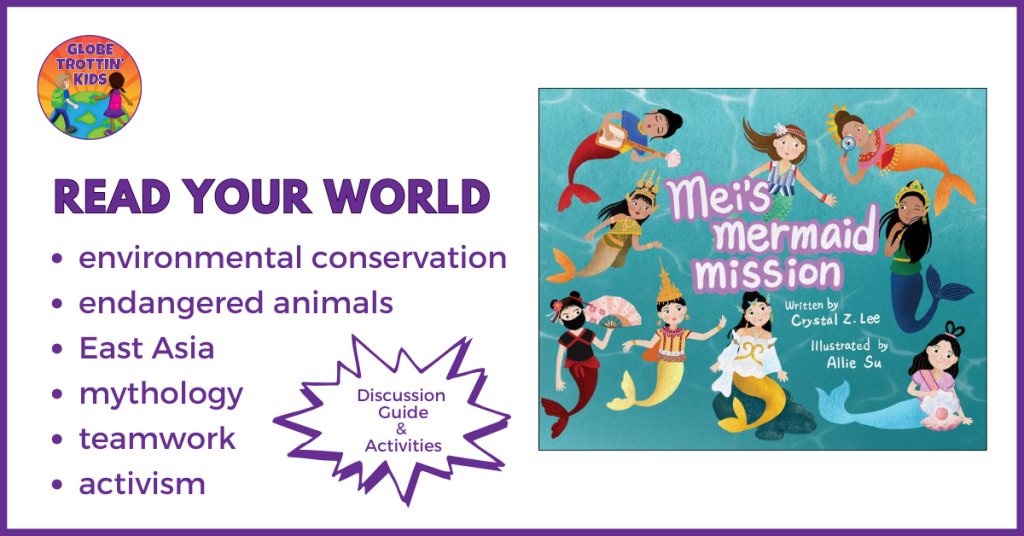
Mei’s Mermaid Mission is an action-packed, ocean-themed adventure that blends imaginative storytelling with a clear, kid-friendly environmental message. With mermaids, pirates, and a globe-spanning cast inspired by Asia-Pacific mythology and history, this picture book is a great choice for educators, librarians, and families looking for stories that both entertain and expand children’s understanding of our diverse world.
Disclosure: We received a complimentary copy of this book for review; however, all opinions are our own. This post contains affiliate links. By clicking through and making a purchase, we receive a small commission at no extra charge to you. All proceeds help support our free global education website. Thank you!
Mei’s Mermaid Mission
Mei is a proud member of the Mermaids International Rescue Alliance (MIRA), and she’s been assigned a high-stakes mission: gather her team and swim to the East Sea, where a notorious troublemaker, Pirate Polymer, is polluting the ocean and putting marine life in danger.
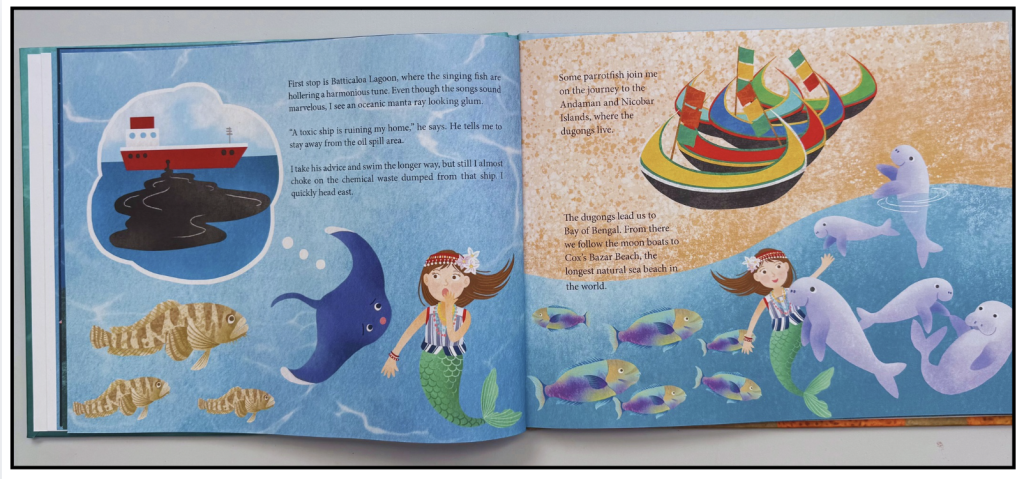
Along the way, Mei and her fellow mermaids encounter a series of urgent environmental problems that many children have heard about but may not fully understand: an oil spill that destroys a manta ray’s habitat, fishing practices that threaten seahorses, a whale shark made sick by plastic, and coral bleaching that turns reefs white.
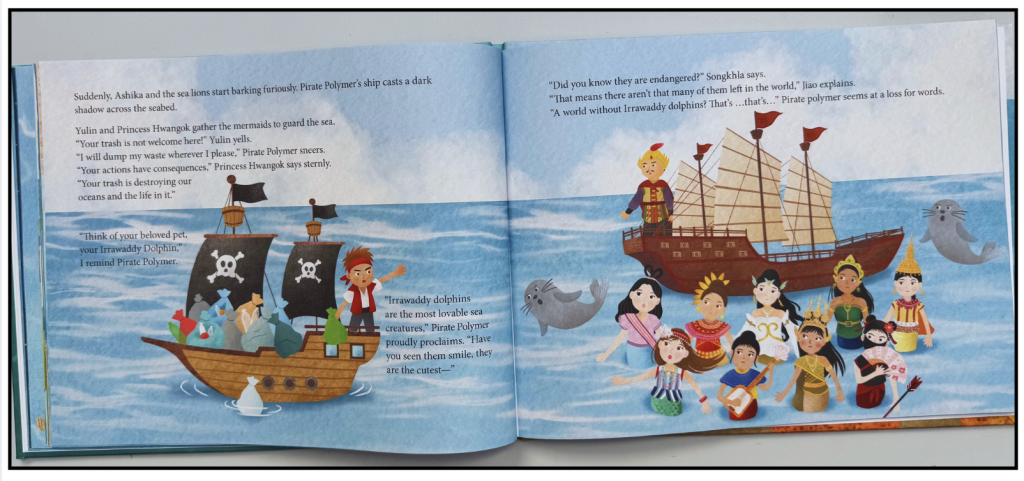
As the mermaids get closer to their destination – passing memorable sea creatures and recognizable locations like Jeju Island – they finally confront Pirate Polymer. What follows is a satisfying moment of problem-solving and accountability that emphasizes a powerful idea for young readers: people can learn, change, and help repair the damage they’ve caused.
Why it works so well for kids (and the adults who read with them)
Even though the book is playful and fantasy-filled, the conservation message lands with real impact. The environmental issues are presented in a way that feels concrete and understandable, making this a strong pick for read-alouds that lead naturally into discussion.
Just as meaningful is the book’s cultural richness. Names and references draw on Asia-Pacific mermaid traditions and legends, including figures associated with places like Korea, Malaysia, and Indonesia, alongside historical touchpoints such as Madame Ching (one of history’s most successful female pirates). The story also nods to specific locations across countries such as India, Vietnam, and Sri Lanka, inviting children to see the ocean as a force that connects communities worldwide.
Classroom, library, and home connections
This is an excellent story for:
- Earth Day/ocean conservation units
- SEL themes like responsibility, empathy, and being part of a solution
- Global learning and “mirrors & windows” reading experiences
- Nonfiction text features practice, thanks to the book’s extensive glossary (great for vocabulary building and research mini-lessons)
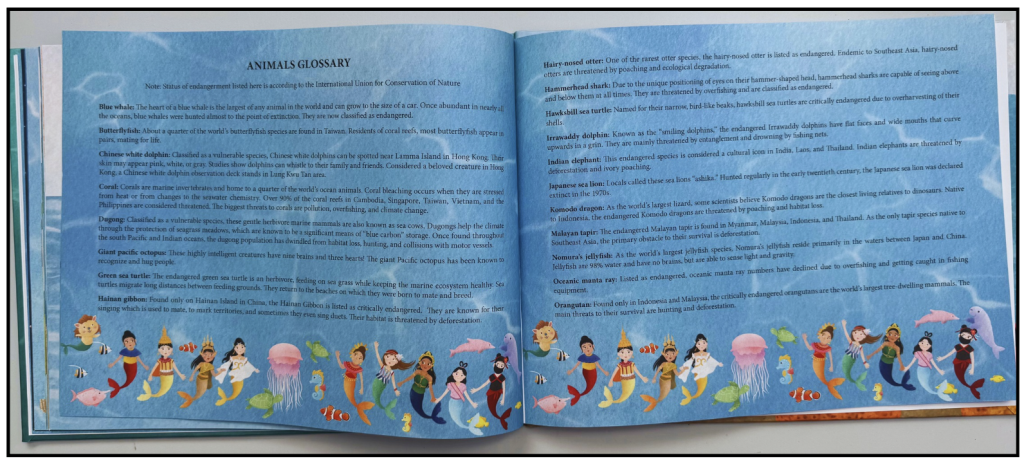
Mei’s Mermaid Mission is the kind of picture book that sparks curiosity on multiple levels: readers learn about marine animals, understand real threats facing ocean ecosystems, and encounter cultural references that widen their sense of the world.
For a Read Your World event, it’s a wonderful example of how diverse children’s literature can be both joyful and deeply meaningful – encouraging kids to care for the planet and appreciate stories rooted in many cultures.
Post-Reading Discussion Questions
- Mei and her team saw several ocean problems. Which one felt the most serious to you, and why?
- Cause and effect: Pick one problem (oil spill, nets, plastic, coral bleaching). What caused it, and what happened to the animals because of it?
- Pirate Polymer changes his actions. What helped him understand the impact of what he was doing? What do you think made him willing to change?
- Teamwork: How did the mermaids work together during the mission? What strengths did different characters bring?
- Point of view: Choose one ocean animal from the story. If it could talk, what would it want humans to know?
- Real vs. fantasy: The story uses mermaids and pirates. How did the author use fantasy to teach something real?
- Problem-solving: If MIRA visited your community (even if you’re far from the ocean), what “mission” might they take on to protect nature nearby?
- Global connections: The book references places and stories from the Asia-Pacific region. Why is it important to read stories that include cultures and locations from around the world?
ACTIVITIES
Science (ocean conservation and simple research)
1) “Save the Sea Creature” mini-poster
- Students choose one animal from the story (manta ray, seahorse, whale shark, etc).
- Include: habitat, what threatens it, and 3 ways people can help.
- Add a labeled illustration and 3 vocabulary words from the glossary.
2) Coral Bleaching Demo (kid-friendly model)
- Use white paper coral outlines or pipe cleaners as “coral.”
- Discuss what reefs need to stay healthy (clean water, stable temperatures).
- Students write: “Coral reefs are important because…” and one action humans can take.
3) Plastic Audit Challenge
- Track classroom/home plastic for one day (wrappers, bottles, bags).
- Make a class chart, then set a one-week goal to reduce or reuse.
Geography (Place-based learning)
4) Map the Mission
- On a map of Asia, students locate and label places mentioned in the story.
- Add compass directions: “From ____ to ____ is (north/south/east/west of).”
5) Ocean Connections
- Discuss: “How do oceans connect countries and people?”
- Students draw arrows showing how pollution in one place can affect animals elsewhere.
Writing (SEL & Persuasive writing)
6) Letter to Pirate Polymer (persuasive writing)
Students write a friendly but firm letter that includes:
- What he did (specific examples)
- Why it matters (effects on animals)
- 3 actions he should take to help
- A hopeful closing line about being part of the solution
7) “MIRA Mission Report” (informational writing)
A one-page report with headings:
- Mission Location
- Problem Discovered
- Evidence
- Solution Plan
- How Humans Can Help
8) Ocean Promise Wall: Each student writes one sentence starter:
- “I can help the ocean by…”
- “I learned that marine animals need…”
Post them on a bulletin board or mural.
Meet the Author & Illustrator
Crystal Z. Lee grew up in a bilingual household in Taiwan and in California. She is an avid traveler and has visited over thirteen countries in Asia. She is the author of children’s books A Unicorn Named Rin and Kai the Dancing Butterfly.
Allie Su was born and raised in a village in Yunlin County, Taiwan. Allie once lived in Korea for some time, volunteering in the area of animal protection. She also illustrated a picture book about Taiwan, Kai the Dancing Butterfly.
Purchase the Book -Amazon
Read Your World 2026 (1/29/26) is in its 14th year!
Valarie Budayr and Mia Wenjen founded this non-profit children’s literacy initiative; they are two diverse book-loving moms who saw a need to shine the spotlight on all of the multicultural diverse books and authors on the market while also working to get those books into the hands of young readers and educators.
Read Your World’s mission is to raise awareness of the need to include kids’ books celebrating diversity in homes and school bookshelves. Read about its mission and history HERE.
Read Your World is honored to be supported by these Medallions:
FOUNDER’S CIRCLE: Mia Wenjen (Pragmaticmom) and Valarie Budayr (Audreypress.com)
Super Platinum Sponsor: Author Deedee Cummings and Make A Way Media
Platinum Sponsors: Language Lizard Bilingual Books in 60 Languages and Jeanne Walker Harvey
Gold Sponsors: Publisher Spotlight
Silver Sponsors: Red Comet Press
Silver Corporate Sponsor: Kathy Choi
Bronze Sponsors: Fabled Films Press
Corporate Sponsor: Crayola Education
Read Your World is honored to be supported by these Author Sponsors!
Authors: Audrey Barbakoff, Federico Erebia, Teddi Ahrens, Stephanie M. Wildman, Maritza M. Mejia, Authors J.C. Kato and J.C.², Eugenia Chu, Dorktales Storytime Podcast, Josh Funk, Frances Díaz Evans, Gaia Cornwall, Eric Clock, Maria Wen Adcock, Diana Huang, Gwen Jackson, Gea Meijering, Amanda Hsiung-Blodgett, Ismee Williams, Karin Fisher-Golton, Kathleen Burkinshaw, Tami Lehman-Wilzig, Daria Marmaluk-Hajioannou, Nancy Tupper Ling, Teresa Robeson, Crystal Z. Lee, Karen Leggett Abouraya, Elly Swartz, Robbin Miller, Shifa Safadi, Tonya Ellis, Lisa Stringfellow, Sylvia Liu, Kimberly Biddle, Robbin Miller, Eric Clock, Tonya Ellis, Nadine Pressley, Natahsa Yim Carter, and Lisa Chong.
Read Your World is Honored to be Supported by our CoHosts and Global CoHosts and by our Partner Organizations!
Check out RYW’s Multicultural Books for Kids Pinterest Board!
FREE RESOURCES from Read Your World Day
- FREE RYW2026 Poster
- FREE Building Community with Bilingual Books 2026 Classroom Kit
- FREE Mental Health Support for Stressful Times Classroom Kit
- FREE Diversity Book Lists & Activities for Teachers and Parents
- FREE Homeschool Diverse Kidlit Booklist & Activity Kit
- FREE Teacher Classroom Activism and Activists Kit
- FREE Teacher Classroom Empathy Kit
- FREE Teacher Classroom Kindness Kit
- FREE Teacher Classroom Physical and Developmental Challenges Kit
- FREE Teacher Classroom Poverty Kit
- Gallery of Our Free Posters
- FREE Diversity Book for Classrooms Program
Register for the Read Your World Virtual Party: https://readyourworld.org/virtualparty
Join us on Thursday, January 29, 2026, at 8 pm EST, celebrating 14 years of Read Your World Day Virtual Party! Register here. This epically fun and fast-paced hour includes multicultural book discussions, addressing timely issues, diverse book recommendations, & reading ideas. We will be giving away a 10-Book Bundle during the virtual party, plus Bonus Prizes as well! *** US and Global participants are welcome. **
Follow the hashtag #ReadYourWorld to join the conversation, and connect with like-minded parts, authors, publishers, educators, organizations, and librarians. We look forward to seeing you all on January 29, 2026, at our virtual party!