
Tooth Traditions Around the World
What happens when a child loses a baby tooth?
Some children carefully tuck it under a pillow for the Tooth Fairy. Others leave it for a tiny mouse, place it inside a slipper, toss it onto a roof, or offer it to the sun.
Losing a tooth is a childhood milestone shared by children around the world, but the traditions connected to it can be wonderfully different. Exploring these customs gives young learners a meaningful way to discover geography, compare cultures, and recognize that families may celebrate the same life event in many different ways.
Tooth traditions are especially engaging for young students as they begin to lose their baby teeth. The topic connects naturally to their lives while opening a window to the wider world.
Teaching Note: Traditions can vary among regions, communities, and individual families. Introduce these examples as customs that some children and families follow rather than practices shared by everyone in a country.
Disclosure: This post contains affiliate links. By clicking through and making a purchase, we receive a small commission at no extra charge to you. All proceeds help support our free global education website. Thank you!
Tooth Traditions Around the World
Invite students to locate each country or region on a world map as they learn about its tooth tradition.
United States and Canada: A Visit from the Tooth Fairy
Many children in the United States and Canada place a lost tooth under their pillow before going to sleep. During the night, the Tooth Fairy takes the tooth and leaves money or a small surprise in its place.
Students may be surprised to discover that the Tooth Fairy is not the traditional tooth collector everywhere in the world!
Spain and Latin America: El Ratón Pérez
In Spain and in many Spanish-speaking communities, children may leave a tooth for El Ratón Pérez, or Ratoncito Pérez, a small mouse who collects lost teeth.
The tooth might be placed under a pillow or left in a special container nearby. During the night, the mouse takes the tooth and leaves money or a small gift behind.
Different countries and families may use different names for the tooth mouse, including El Ratón, Ratón Pérez, or Ratoncito Pérez.
France: La Petite Souris
Many children in France wait for La Petite Souris, which means “the little mouse.”
Like the Tooth Fairy, the little mouse visits during the night. A child places the lost tooth under a pillow, and La Petite Souris exchanges it for a coin or small treat.
South Africa: A Tooth in a Slipper
Some children in South Africa place a lost tooth inside a slipper rather than under a pillow. During the night, a mouse may collect the tooth and leave a small gift in its place.
Ask students to compare this custom with the Tooth Fairy tradition. What is similar? What is different?
Botswana: Throw It on the Roof
In Botswana, some children throw a lost tooth onto the roof of their home.
The tooth may be left for a mouse or another animal, along with the hope that the child’s new adult tooth will grow in strong and healthy. Botswana is one of several places where roofs and animals are part of tooth-loss traditions.
South Korea: A Tooth for a Bird
Some children in South Korea toss a lost tooth onto the roof. Traditionally, they may ask a magpie or another bird to take the old tooth and bring them a strong new one.
Vietnam: Up or Down?
In one Vietnamese tradition, what happens to a tooth depends on where it came from.
A tooth lost from the upper part of the mouth may be thrown underneath the bed or house. A tooth from the lower part of the mouth may be tossed onto the roof. The direction is connected to the hope that the new tooth will grow properly.
Mongolia: A Treat for the Dog
In one Mongolian tradition, a child’s lost tooth may be placed inside a small piece of meat or fat and given to a dog.
Dogs are respected for having strong teeth, so the custom expresses the hope that the child’s new tooth will grow in just as strong.
Parts of the Middle East and North Africa: A Tooth for the Sun
In some communities in the Middle East and North Africa, children throw a lost tooth toward the sun. They may say a rhyme asking the sun to take the old tooth and replace it with a strong new one.
This custom does not usually involve receiving money or a gift. Instead, it focuses on the wish for healthy adult teeth.
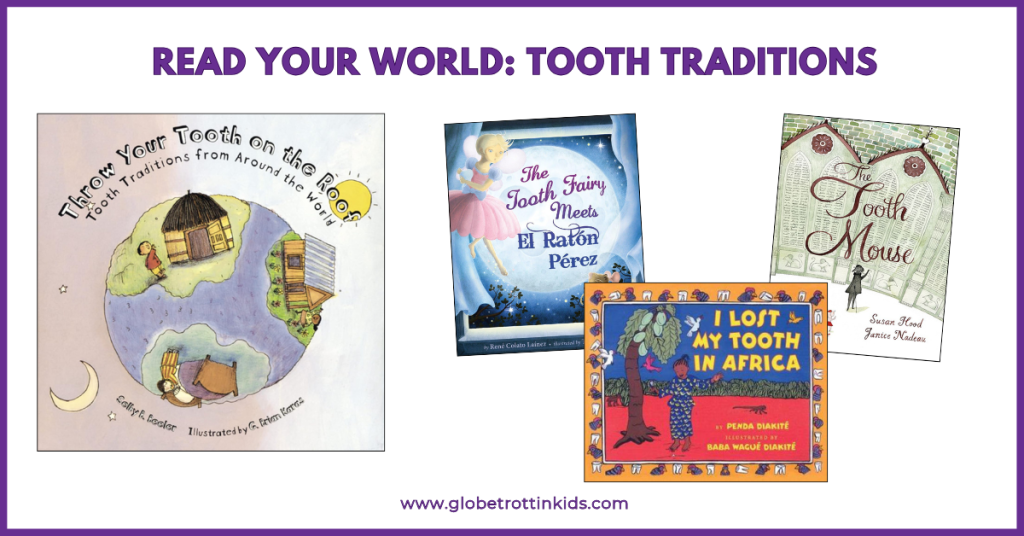
Featured Book: Throw Your Tooth on the Roof
Throw Your Tooth on the Roof: Tooth Traditions from Around the World by Selby B. Beeler, illustrated by G. Brian Karas, is an excellent introduction to global tooth traditions.
The book takes readers on a quick trip around the world to discover what children do when they lose their baby teeth. Its short descriptions, lively illustrations, and world map make it especially useful for young learners. The book includes traditions from places such as Botswana, Afghanistan, Egypt, Venezuela, Spain, and Korea.
Classroom Connection: Pair Throw Your Tooth on the Roof by Selby B. Beeler with this Tooth Traditions Around the World book companion. Your students can map countries, compare traditions, sequence events, and complete creative reading and writing activities – all while making meaningful connections to a childhood milestone they know well.
More Picture Books About Tooth Traditions
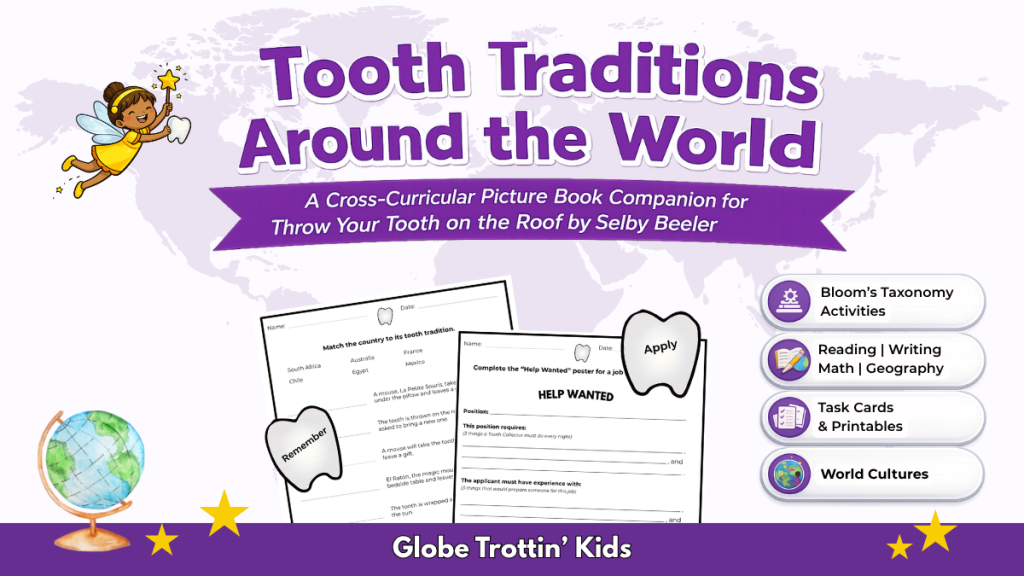
The Tooth Fairy Meets El Ratón Pérez by René Colato Laínez
Miguelito comes from a Mexican American family, and both the Tooth Fairy and El Ratón Pérez arrive to collect his tooth. The two tooth collectors must decide who should take it.
This story is a fun way to explore how children may belong to more than one cultural tradition. It can also begin a conversation about families that combine, adapt, or create their own customs.
Classroom connection: Ask students to design a solution that allows both characters to participate in Miguelito’s celebration.
I Lost My Tooth in Africa by Penda Diakite
More than anything, Amina wants to lose her loose tooth while visiting her family in Mali, West Africa. Only then can she put it under a gourd for the African tooth fairy, who will exchange it for two chickens! Happily, this happens, and even better, the chickens lay eggs. But will the eggs hatch before it’s time to return home to America?
The Tooth Mouse by Susan Hood
In this imaginative story inspired by the French tooth-mouse tradition, La Petite Souris is ready to retire. A group of young mice competes to become her successor, but the winner must demonstrate bravery, honesty, and wisdom.
Classroom connection: Have students identify examples of each character trait and explain which trait is most important for a tooth collector.
Classroom Activities
During the Story: Map the Traditions
Place a large world map where students can reach it. After learning about each tradition, add a tooth-shaped marker to the corresponding country.
After the Story: Create a Class Book
Make a collaborative book titled What in the World Would You Do with Your Tooth?
Each student completes one page:
If I lost a tooth in __________, I would __________.
Students can describe a real tradition or create a new one. Add a map showing all the places represented in the class book.
A Small Tooth with a Big Global Connection
Losing a tooth may seem like a small event, but it offers a wonderful opportunity for global learning.
Whether a tooth is tucked beneath a pillow, placed inside a slipper, given to a mouse, or tossed onto a roof, each tradition reflects imagination, family, community, and hope for the future.
As students compare these customs, they discover an important global lesson: children around the world experience many of the same milestones, even when they celebrate them in different ways.