Celebrate Black Poetry Day with Amanda Gorman Picture Books
Black Poetry Day, observed on October 17, is an opportunity to introduce students to the voices and contributions of Black poets – past and present. For elementary classrooms, Amanda Gorman’s picture books provide an engaging and accessible way to explore poetry while opening conversations about hope, community, courage, and the power of using our voices.
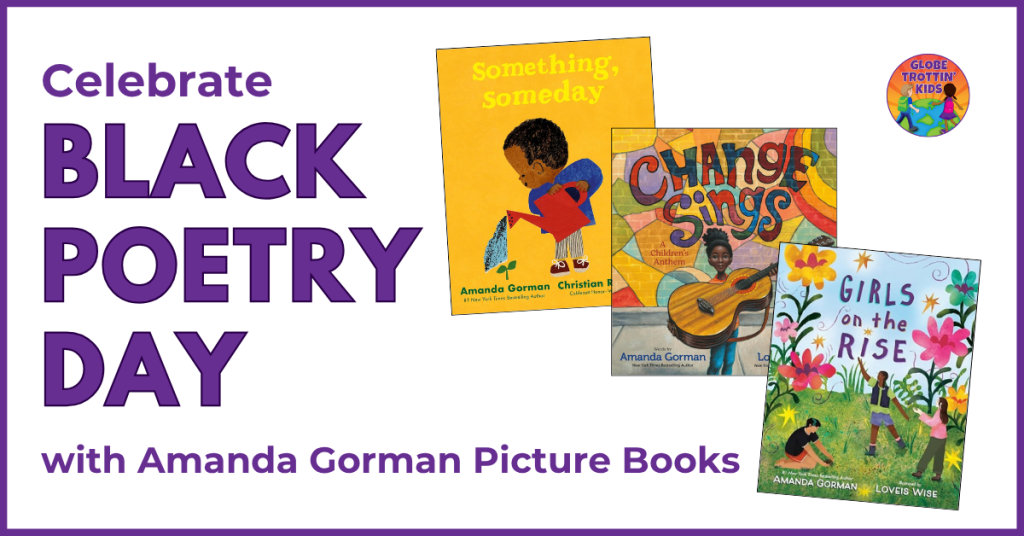
Three of Gorman’s picture books, Change Sings: A Children’s Anthem, Something, Someday, and Girls on the Rise – offer meaningful connections for young learners. Change Sings celebrates the power of joining our voices and actions together. Something, Someday reminds children that even when a problem feels too big, change can begin with one small step. Girls on the Rise celebrates girls – their strength, potential, individuality, and ability to shape the future.
Together, these books invite students to experience poetry not only as something to read, but also as a powerful way to express ideas, imagine possibilities, and share their own voices.
Disclosure: This post contains affiliate links. If you click through and make a purchase, we receive a small commission at no extra charge to you. All proceeds help support our free global education website. Thank you!
Change Sings: A Children’s Anthem
Meet Amanda Gorman
Introduce Amanda Gorman as an American poet and author who became the first National Youth Poet Laureate of the United States. Explain that she often writes about hope, community, belonging, and people’s ability to create positive change.
1. Tell students that Change Sings is a picture book written as a poem. As they listen, ask them to think about what it means to “be the change” instead of waiting for change to happen.
2. Read Change Sings aloud. Encourage students to listen to the sound and rhythm of the words as well as the story they tell. Pause occasionally to examine Loren Long’s illustrations and notice how the group grows as the story progresses.
After reading, create a Notice & Wonder chart.
I Notice…
- words or ideas that repeat
- words that have a strong rhythm
- examples of kindness or helping
- how the group changes throughout the book
- ways the illustrations support the words
I Wonder…
- why Gorman connects change with music
- why more children join along the way
- what the instruments might represent
- why the author chose the word sing
- what message she wants readers to remember
3. Explore the Message
Discuss:
- What kinds of change do you notice in the story?
- What actions do the children take?
- How do small individual actions become something bigger?
- Why do you think Gorman compares change to a song?
- How do the illustrations help tell the story?
- What do you think the book’s main message is?
Introduce or review the idea of metaphor. Explain that the title Change Sings doesn’t simply mean singing a song. Gorman connects music and change throughout the book to help readers imagine what can happen when individual people contribute their own actions and voices to something larger.
Ask: If every person has something to contribute, what might happen when those contributions come together?
4. Write “Change Begins With…”
Invite students to think about a positive change they would like to see in their classroom, school, community, or world.
Brainstorm possibilities, such as including others, reducing waste, protecting animals and nature, helping someone in need, welcoming newcomers, showing kindness, or learning about people whose experiences are different from their own.
Students can begin by brainstorming with these prompts:
Change begins when…
I can…
My voice can…
Together we can…
I imagine a world where…
Then have students transform their ideas into a 5-8 line free-verse poem titled “Change Begins With Me” or a title of their own choosing.
Encourage them to experiment with repetition, rhythm, strong verbs, and imagery.
Invite volunteers to read their poems aloud. Students can also add a small illustration representing their vision of change.
🖨️ Change Sings Educator Guide
5. Closing Connection to Black Poetry Day
Explain that Black Poetry Day, observed on October 17, celebrates the contributions and voices of Black poets past and present. Amanda Gorman is part of this continuing literary tradition.
Teaching Tip: Emphasize that creating change doesn’t always require doing something huge. Individual acts of kindness, service, creativity, courage, and cooperation can contribute to something larger.
Optional Extension: Our Classroom “Change Sings” Mural
Create a collaborative display demonstrating how individual actions can become collective change.
Give each student a paper music note. On it, have them write one realistic action they can take to improve their classroom, community, or world.
Arrange the notes together on a musical staff under the heading: Change Sings When We All Play a Part
Something, Someday
Meet Amanda Gorman
Introduce Amanda Gorman as an American poet and author who became the first National Youth Poet Laureate of the United States. Explain that she often writes about hope, community, belonging, and people’s ability to create positive change.
1. Tell students that Something, Someday is a picture book written with poetic language. As they listen, ask them to think about this question:
Can one person make a difference, even when a problem seems too big to solve?
2. Read Something, Someday aloud. Pause occasionally to give students time to examine Christian Robinson’s illustrations and notice how the words and pictures work together.
🎧 Listen to Amanda Gorman read Something, Someday:
After reading, create a Notice & Wonder chart.
I Notice…
- words or ideas that repeat
- words that create strong feelings
- changes in the illustrations
- examples of someone taking action
- ways people work together
I Wonder…
- why the author repeats certain ideas
- why the character keeps trying
- how small actions can lead to bigger changes
- what Amanda Gorman wants readers to remember
3. Explore the Message
Discuss the book as a class:
- What problem does the character notice?
- How do other people respond at first?
- What does the character decide to do?
- What happens when other people begin to help?
- What do you think “something, someday” means in the story?
- What message does Amanda Gorman want readers to take away from the book?
Guide students toward the idea that change does not always happen all at once. Small actions, persistence, hope, and working together can make a difference.
Connect this idea to poetry. Explain that poets choose words carefully to help readers see, feel, think, and imagine. Gorman uses simple but powerful language and repetition to emphasize her message.
4. Write: “Something I Can Do”
Ask students to think about something they would like to make better. It might be something in their classroom, neighborhood, or the wider world.
Brainstorm examples such as welcoming someone who feels left out, caring for the environment, helping people in need, or being kinder to others.
Students can use these prompts to begin a free-verse poem:
I notice…
I wish…
Maybe I can…
Something small can…
Together, we can…
Someday…
Encourage students to turn their ideas into a 5-8 line poem. They can experiment with repetition, descriptive words, and strong verbs.
Invite students who are comfortable doing so to share their poems aloud.
5. Closing Connection to Black Poetry Day
Explain that Black Poetry Day, observed on October 17, celebrates the voices and contributions of Black poets past and present. Amanda Gorman is one contemporary poet whose writing demonstrates how poetry can communicate ideas, inspire hope, and encourage people to imagine positive change.
Ask students: What is one small “something” you could do today that might make a difference someday?
Optional Extension: From Poetry to Action
Turn students’ poems into a “Something, Someday: Small Actions, Big Possibilities” classroom display. Next to each poem, students can add a small action they can realistically take.
Girls on the Rise
Girls on the Rise, written by Amanda Gorman and illustrated by Loveis Wise, is a joyful celebration of girls and their potential to dream, lead, create, and make a difference. Its lyrical language and uplifting message make it a natural addition to a Black Poetry Day exploration of Gorman’s work. The book also provides an opportunity to talk about individuality and empowerment while encouraging all students to consider how they can support and celebrate the girls in their lives and communities.
Extend the Learning
- Discuss the word rise. What might it mean beyond physically moving upward? Ask students to identify ways the girls in the book “rise” through their ideas, actions, dreams, or strengths. Create a class chart of different meanings and examples.
- Read the book again and have students listen for words and phrases that communicate strength, possibility, courage, or hope. Discuss how Gorman’s word choices make the reader feel. Then invite students to choose several powerful words and use them as inspiration for a short poem of their own.
- Invite students to choose a girl or woman – someone they know, a historical figure, or a contemporary changemaker – who inspires them. Students can write a short poem, paragraph, or “She Rises Because…” tribute explaining what makes that person inspiring. Extend the activity by locating the person’s country or place of origin on a world map.
Black Poetry Day can be more than an introduction to a poet – it can be an invitation for students to discover the power of poetry and their own voices. Through Change Sings, and Something, Someday, and Girls on the Rise, students can explore how Amanda Gorman uses lyrical language to communicate hope, imagine possibilities, and encourage positive action.
Each book offers a slightly different message, but together they remind young readers that their ideas, words, dreams, and actions matter.
Related Resources: