Diwali for Kids: Discover the Festival of Lights
Every autumn, millions of people around the world celebrate Diwali (also called Deepavali), the Festival of Lights!
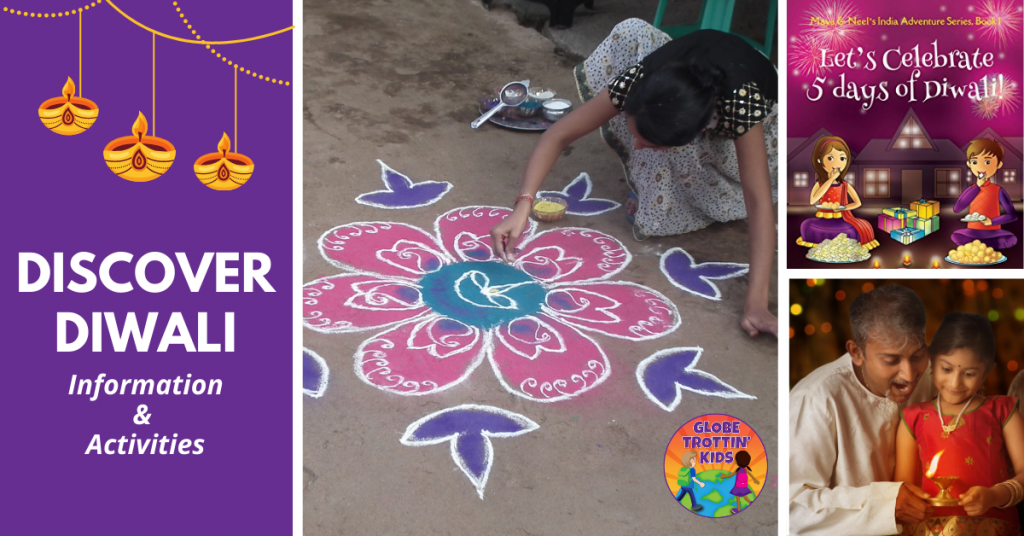
Discover the meaning and traditions of this important holiday, explore how it is celebrated around the world, and find children’s books and engaging classroom activities to bring Diwali to life for young learners.
Disclosure: This post contains affiliate links. If you make a purchase through these links, Globe Trottin’ Kids may receive a small commission at no additional cost to you. Your support helps keep our global education website free. Thank you!
What is Diwali?
Diwali is one of the most important holidays in Hinduism and is celebrated throughout India and in communities around the world.
The name Deepavali comes from the Sanskrit words meaning “row of lights,” referring to the small lamps traditionally lit during the festival.
For many families, these lights symbolize hope, wisdom, goodness, and the triumph of light over darkness.
Diwali also marks a time of renewal, gratitude, and togetherness. Families may clean and decorate their homes, wear new clothes, prepare special foods, offer prayers, and spend time with loved ones.
Although Diwali is most closely associated with Hinduism, this festive season also holds important religious significance for Jain and Sikh communities.
When Is Diwali Celebrated?
Diwali takes place in October or November, with its dates determined by traditional lunar calendars. The main Hindu celebration often falls on the darkest night of the lunar month when there is a new moon.
Upcoming Diwali dates:
- 2026: November 8
- 2027: October 29
Many Hindu communities celebrate over approximately five days, although the timing, length, and traditions vary by region and family.
Why Is Diwali Celebrated?
Diwali celebrates the triumph of light over darkness, good over evil, and knowledge over ignorance. The holiday has different meanings and traditions across religious communities and regions.
For many Hindus, Diwali honors the return of Prince Rama, his wife Sita, and his brother Lakshmana to their kingdom after 14 years in exile and Rama’s victory over the demon king Ravana. According to tradition, the people welcomed them home by lighting rows of oil lamps. Diwali is also associated with Lakshmi, the goddess of wealth and prosperity, and other Hindu stories and traditions.
For Jains, Diwali commemorates the spiritual liberation of Mahavira, an important religious teacher. Sikhs observe Bandi Chhor Divas around the same time, celebrating the release of Guru Hargobind from imprisonment.
Although the stories and customs differ, light is a meaningful symbol of hope, wisdom, and new beginnings throughout these celebrations.
The Five Days of Diwali
In many Hindu communities, Diwali celebrations follow a series of five observances. Each has its own customs and significance.
Day 1: Dhanteras – Preparing for Prosperity
Families clean and decorate their homes in preparation for the festival. Some purchase new household items or jewelry as symbols of good fortune and new beginnings.
Day 2: Naraka Chaturdashi – Celebrating Goodness
Also known as Chhoti Diwali (Little Diwali), this day is connected in many traditions with Krishna’s victory over Narakasura. Families bathe early, light lamps, and prepare special foods. In parts of southern India, this is the main day of Deepavali celebrations.
Day 3: Diwali – The Festival of Lights
For many families, this is the main evening of celebration.
Homes glow with diyas and strings of lights. Families gather for Lakshmi Puja, a religious ceremony honoring the goddess Lakshmi, and may exchange sweets and gifts. In some communities, colorful decorations, festive meals, and fireworks add to the celebration.
Day 4: Govardhan Puja and New Beginnings
In some Hindu traditions, this day honors Krishna’s protection of a community from a powerful storm. Special offerings of food may be prepared as expressions of gratitude.
Other communities celebrate the Hindu New Year or observe different regional traditions.
Day 5: Bhai Dooj – Celebrating Family Bonds
This day celebrates the special relationship between a brother and a sister. Families may gather for meals, blessings, and gift exchanges. The day emphasizes love and family connections.
Did You Know?
Not all Hindu families celebrate these five days in the same way or even on the same dates. India’s many languages, regions, and traditions contribute to the wonderful diversity of Diwali celebrations.
Diwali Traditions and Their Meanings
1. Lighting Diyas
Diyas are small clay lamps traditionally filled with oil or ghee and lit with a cotton wick. During Diwali, families arrange rows of diyas along windowsills, doorways, courtyards, and other spaces. Their light symbolizes goodness, wisdom, and hope overcoming darkness. Today, many families also decorate with candles, lanterns, and electric lights.
2. Creating Colorful Rangoli
Rangoli is a traditional decorative art form often created on floors or at the entrance to homes. Artists use colorful powders, rice flour, sand, or flower petals to make beautiful geometric patterns, flowers, and other designs. During Diwali, rangoli designs are used to welcome guests, symbolize good fortune, and decorate homes. Designs and techniques vary across India, and similar decorative traditions have different regional names.
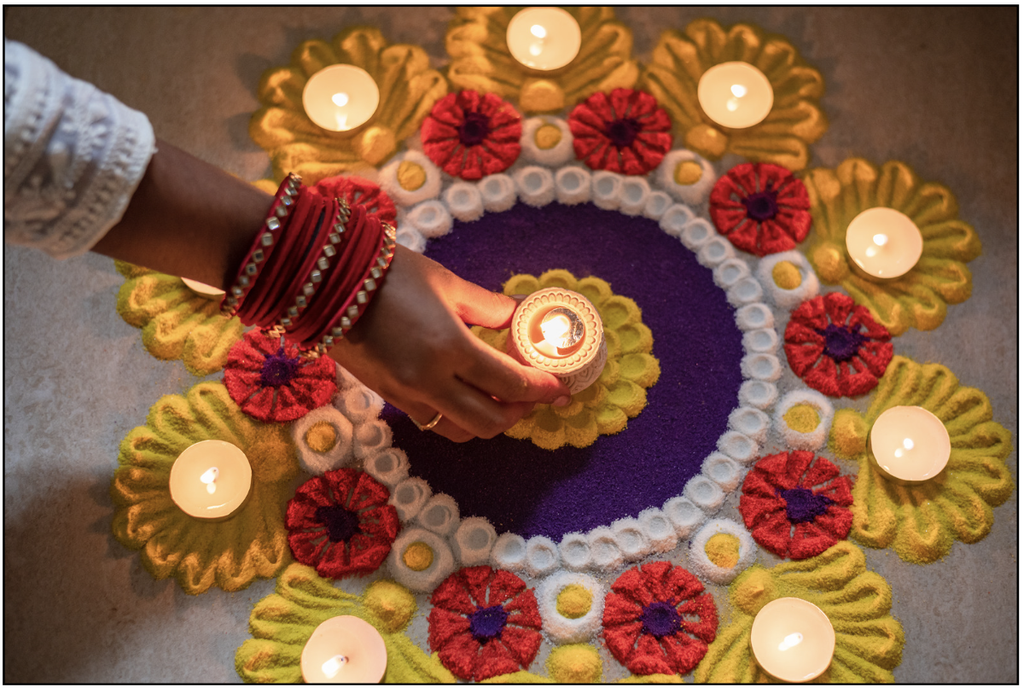
Look Closer: Many rangoli patterns feature symmetry, repeated shapes, and intricate geometric designs – making them a wonderful connection to math and art!
3. Sharing Sweets and Special Foods
Food is an important part of Diwali celebrations, bringing families and friends together.
Traditional treats vary by region and family, but may include:
- Laddu: Round sweets often made with flour, sugar, and ghee.
- Barfi: A dense, sweet confection made with ingredients such as milk, nuts, or coconut.
- Jalebi: A crispy, spiral-shaped sweet soaked in sugar syrup.
- Kaju katli: A thin, diamond-shaped sweet made from cashews.
- Samosas: Savory pastries filled with spiced vegetables or other ingredients.
Families prepare homemade favorites, share sweets with neighbors, and exchange beautifully decorated gift boxes.
4. Decorating Homes and Wearing New Clothes
In preparation for Diwali, many families thoroughly clean their homes and decorate them with flowers, lights, and colorful artwork. Some wear new or special clothing to mark the festive occasion. These traditions often symbolize a fresh start and the welcoming of good fortune.
5. Celebrating with Family and Community
Diwali is a time for family gatherings, visiting friends, exchanging gifts, and enjoying community celebrations. Some communities organize music and dance performances, fairs, and fireworks displays.
Where Is Diwali Celebrated Around the World?
Diwali has its roots in South Asia, but its celebrations extend far beyond India. Today, Diwali is observed in countries including Nepal, Singapore, Malaysia, Fiji, Mauritius, Guyana, Trinidad and Tobago, and the United States.
Diwali Books & Activities
Picture books are a wonderful way to introduce young learners to the customs, stories, and experiences associated with Diwali.
These engaging titles offer opportunities for read-alouds, discussions, cultural comparisons, and cross-curricular learning.

The Light Within You Diya travels to India to celebrate Diwali with her beloved grandmother, Nani. Through their time together, she discovers the joy of family traditions and the special connection between loved ones, even when they live far apart.
⦿ Extend the Learning: Discuss how families preserve cultural traditions when they move to another country. What does the idea of sharing your “inner light” mean?
Let’s Celebrate 5 Days of Diwali! Join Maya, Neel, and their squirrel friend Chintu as they explore the traditions and festivities associated with the five days of Diwali.
⦿ Extend the Learning: After the read-aloud, students can create a simple illustrated timeline of the celebration.
Make your own Decorative Diya with these step-by-step directions from Culture Groove.
Diwali Activity Book 50 activities to celebrate Diwali along with Maya, Neel, and their cute little partner, Chintu the squirrel, through Storytime, Dance-along, Crafts, Recipes, Puzzles, Word games, Coloring & More!
Binny’s Diwali Binny is excited – and a little nervous- to share her family’s Diwali traditions with her classmates. Through her presentation, students learn about colorful decorations, special foods, and the meaning of the festival.
⦿ Extend the Learning: Discuss how Binny feels about sharing her culture. What can classmates do to make everyone feel comfortable and proud of their traditions?
It’s Diwali! This lively counting book introduces Diwali through colorful illustrations, rhyming text, and familiar holiday traditions.
⦿ Extend the Learning: Practice counting and number patterns while identifying the cultural details included in each illustration.
Diwali (Celebrate the World) This beautifully illustrated introduction explores the traditions and meaning of the Festival of Lights, including family celebrations, prayer, and the importance of kindness and goodness.
⦿ Extend the Learning: Have students identify three symbols or traditions they learned about and explain why each is meaningful.
My Diwali Light Follow Devi as she celebrates Diwali with her family, friends, and neighbors. Through food, decorations, and family traditions, she discovers the joy of sharing her light with others.
⦿ Extend the Learning: Ask students how people can bring kindness and positivity to their own communities.
My Diwali Coloring Book Coloring fun for all ages, plus a simple read-along narrative.
5 Engaging Diwali Classroom Activities
These low-prep activities help elementary students explore the holiday through geography, art, math, literacy, and meaningful discussions.
1. Explore Diwali Through Photographs
Display photographs of Diwali celebrations, including glowing diyas, rangoli designs, festive foods, and family gatherings.
Ask students:
- What do you notice?
- What traditions do you recognize?
- What might these objects symbolize?
- What questions do you have?
2. Design a Rangoli Pattern
Begin by showing photographs of authentic rangoli designs and discussing their cultural significance. Invite students to create rangoli-inspired artwork on paper using crayons, colored pencils, or cut-paper shapes.
Challenge them to include:
- At least two lines of symmetry
- Repeating geometric shapes
- A colorful pattern
Extend the Learning: Have students explain the mathematical features of their designs.
Related resources:
- Learn How to Make Rangoli with illustrated step-by-step directions.
- Get inspired with these Easy Rangoli Designs.
3. Create a Decorative Diya
After discussing the symbolism of diyas, students can decorate a paper illustration or model of a traditional clay lamp. Use battery-operated tea lights if creating a classroom display.
Discussion Question: Why are lights such an important symbol during Diwali?
Related resource: Culture Groove’s Paper Diya Activity
4. Map Diwali Around the World
Locate India on a world map and explore its location in South Asia. Then find other places where Diwali is celebrated, including Nepal, Singapore, Mauritius, Fiji, and Trinidad and Tobago. Students can mark these locations on a map and research one way the holiday is observed in each place.
Discussion Question: How can a holiday that began in one part of the world become an important tradition in other countries?
5. Share Your Light: Kindness and Connection
Explain that the symbolism of light during Diwali often represents goodness, knowledge, hope, and positivity. Invite students to reflect on how their own actions can make a positive difference.
Ask:
- What does it mean to be a light in someone’s life?
- How can a small act of kindness brighten someone’s day?
- What can we do to make our classroom a welcoming place?
Students can write or illustrate one action they can take to bring positivity to their community.
Create a class display titled “Let Your Light Shine!” to celebrate their ideas.
More Diwali Learning Resources
Explore these trusted resources for photographs, videos, cultural information, and additional learning opportunities.
- Smithsonian National Museum of Asian Art – Diwali: Explore the traditions of Diwali through art, cultural programs, and educational resources.
- Hindu American Foundation – Diwali Toolkit: Find background information, an animated video, and downloadable learning activities.
- Google Arts & Culture – Rangoli for Diwali: Discover different rangoli styles, materials, and designs from across India.
- Nepal Tourism Board – Tihar: Learn about Nepal’s colorful festival of lights and its unique traditions.
Teacher Tip: When teaching about Diwali, remember that not everyone in India celebrates the holiday, and traditions differ among families and religious communities. Focus on understanding its meaning rather than only completing crafts. Use authentic books, photographs, and community-created resources whenever possible. Students can learn about religious traditions without participating in religious ceremonies.
Explore India with Globe Trottin’ Kids!
Extend your Diwali learning with a virtual journey to India!
Discover India’s geography, landmarks, people, languages, foods, and cultural traditions through a collection of kid-friendly maps, photographs, videos, and activities.
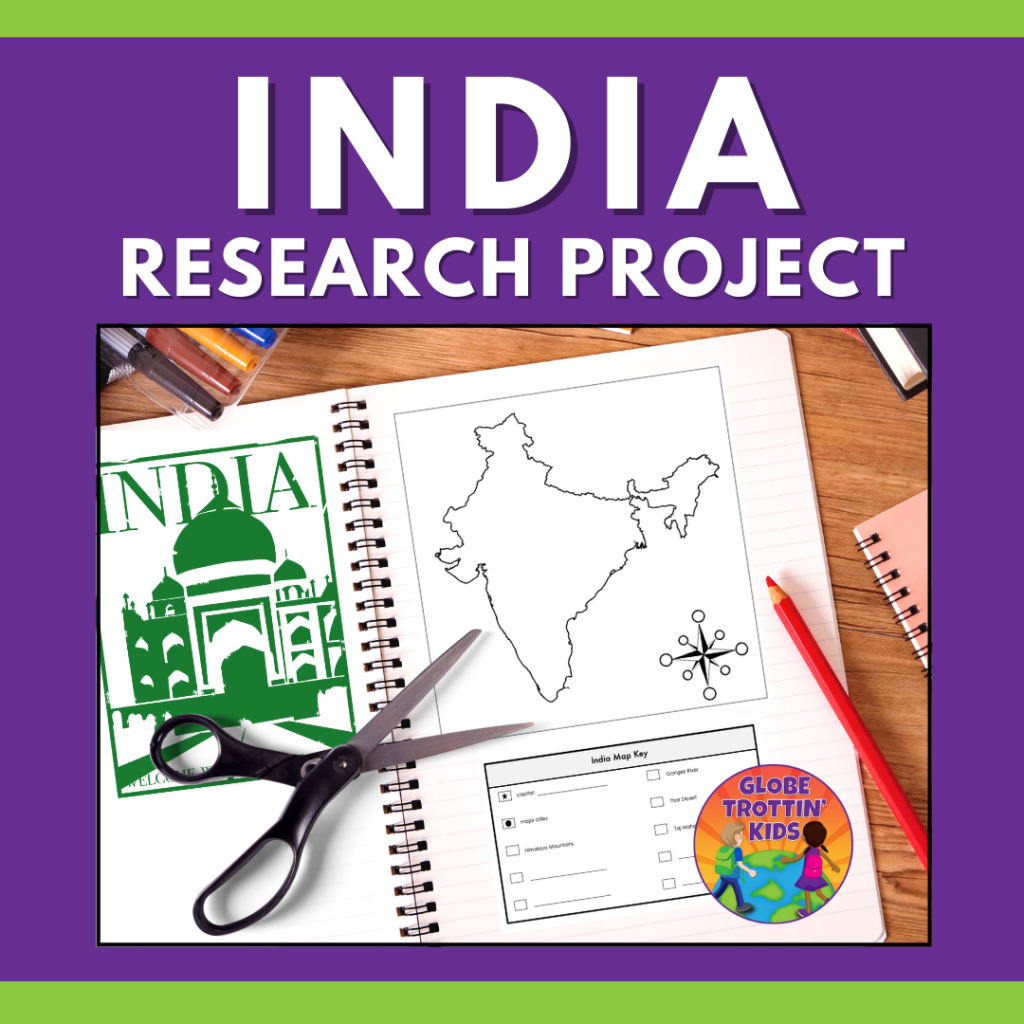
India Country Research Project
Take learning a step further with our printable country research project. Students build geography and research skills while exploring the diverse people, places, and cultures of India.
Related Posts
Discover Holi, India’s Festival of Colors.
Learn about Mohandas Gandhi and his impact on the world through a video, books, free curriculum guides, and engaging activities.